Cities · 2026
Capturing urban activities and environment across time scales: Object detection and time-series analysis of 6.8 million images in Accra, Ghana
A short write-up of this paper in my own words is on its way. In the meantime, the official abstract is below and the full paper is linked above.
Official abstract
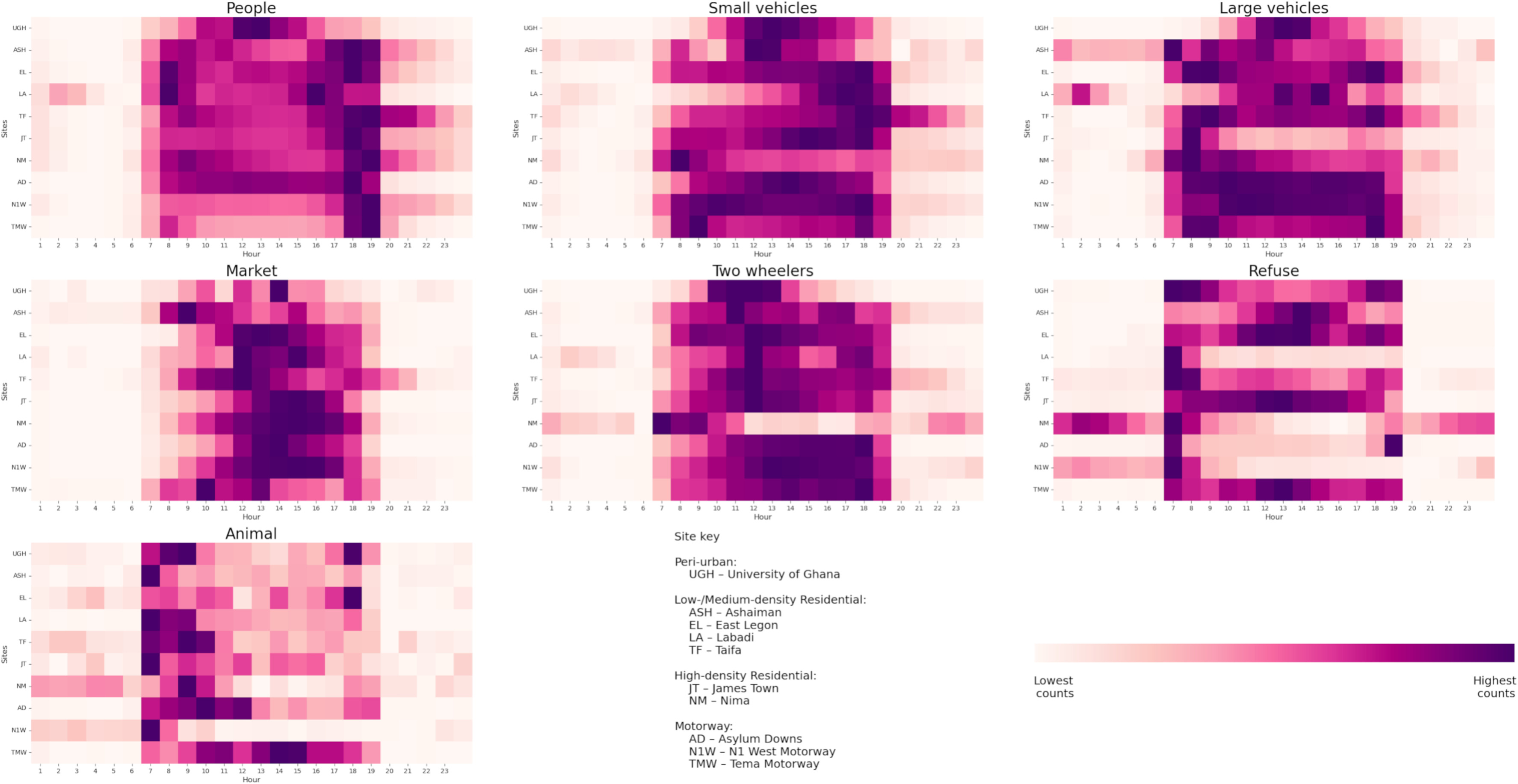
Cities have complex dynamics on timescales from hourly and daily changes to monthly shifts and annual trends. We used time-lapsed street-view imagery (SVI) to capture and analyse temporal trends of urban environmental features in Accra, Ghana. We collected a novel dataset of 6.8 million street-view images (SVI) at five-minute intervals over five years at ten representative locations in Accra, Ghana. We used a fine-tuned YOLOv7 object detection model to detect and obtain counts of people, large vehicles, small vehicles, two-wheelers, market-related objects, refuse and animals in all images. We used a mixed-effects zero-inflated negative binomial model with indicators for hour of day, day of week, week of year, and year to consistently and coherently identify temporal patterns of object counts across time scales and sites. People and small vehicles were most prevalent in mid-morning and early evening, and market-related objects peaked in early afternoon. The number of people, vehicles and market-related objects declined on weekends at most sites, although two residential sites showed an inverse trend, peaking in all three categories on weekends. Long-term trends over the years indicate a rise in people at high-density residential sites. Over the same period, market-related objects, two-wheelers and small vehicles declined at several locations with different land-use characteristics, suggesting broad shifts in transport and commercial activity. These results demonstrate the potential of SVI and computer vision for urban monitoring to support strategies for improving mobility, traffic congestion, pollution, access to goods and services, and waste management.
DOI: 10.1016/j.cities.2026.107203